The sharp rise in gold prices is creating a growing issue for the private client insurance market. While geopolitical uncertainty and investor demand may be driving the headlines, for insurers the more practical consequence is that the replacement cost of jewellery, watches and other precious-metal assets can move well beyond the values recorded on a policy.
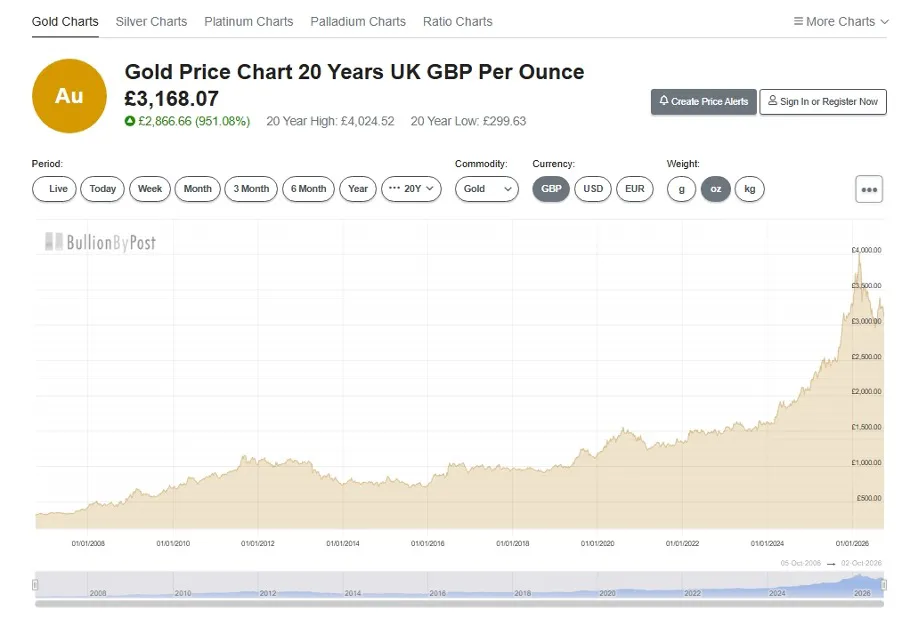
Source: https://www.bullionbypost.co.uk/gold-price/20-year-gold-price- chart-ounce-gbp/#show-chart
Gold prices have risen particularly rapidly over the past two years, as can be seen in the above chart, substantially outpacing general inflation. For policyholders who have not recently reviewed their sums insured, the result can be a significant gap between the value of an item when it was last assessed and the amount required to replace it today.
For private client insurers, brokers and adjusters, that gap is increasingly becoming apparent at the point of claim.
When rising values meet fixed limits
Gold is held in many different forms. Alongside jewellery and watches, McLarens encounters claims involving policyholders who hold physical gold as an investment or intend to gift it to their children.
This creates challenges where items have not been individually specified. Many policies contain fixed limits for gold or precious metals, separate from jewellery limits, which can leave policyholders significantly underinsured following rapid increases in value.
The issue extends well beyond gold bullion. Most private client claims involving precious items relate to the loss, theft or accidental damage of jewellery and watches. Where these assets have not been revalued regularly, their current replacement cost can exceed both individual item limits and the overall sums insured.
From a claims perspective, the position may be relatively straightforward: indemnity is determined by the policy wording and applicable limits. The customer experience can be much more difficult. A policyholder may reasonably expect insurance to enable them to replace a lost item, only to discover that its value has risen substantially beyond the available cover. McLarens is seeing more instances where customers want specified items replaced but the sum insured is no longer sufficient to do so.
How quickly can values change?
The scale of the movement can be striking. Rachel Doerr, Managing Director at Doerr Dallas Valuations, has observed a clear trend towards underinsurance as sustained increases in precious-metal prices feed through into replacement values.
According to Rachel: “Jewellery that was accurately valued just a few years ago can now fall materially short of current replacement levels, particularly where items sit within unspecified limits and gaps in cover can easily arise. Jewellery that has not been valued in the last two years will see a level of underinsurance today.”
Rachel points to some individual examples that illustrate the issue: “An 18ct gold Cartier Love bracelet costing approximately £5,500 in 2021 had risen to around £7,050 by 2023, with the current retail price cited in the source material at approximately £11,400.”
“Another example involves a three-stone Tiffany diamond engagement ring bought for around £4,000 in 2016. Its replacement value had risen to approximately £6,500 by 2020 but is now estimated at £25,000.”
Depending on the policy, that could take an item that once comfortably sat within the available cover beyond the applicable single-item limit.
A problem that often emerges too late
One of the difficulties with jewellery underinsurance is that it can remain largely invisible until a loss occurs.
Unlike increases in household expenditure or energy costs, changes in the replacement value of jewellery do not necessarily affect a policyholder’s everyday finances. An engagement ring or watch may remain in regular use for many years without its owner having any reason to establish what replacing it would now cost.
That can create a disconnect between the asset the customer believes they have insured and the financial protection the policy actually provides.
It is particularly relevant in the high-net-worth market, where individual collections can include jewellery and watches acquired over many years. Even where items were appropriately valued when first added to the policy, rapidly changing prices mean those valuations can become outdated much faster than historically expected.
Rethinking the valuation cycle
The most effective response is relatively straightforward: more regular valuations.
There is currently no universal industry standard governing how frequently jewellery valuations should be updated, making proactive engagement particularly important.
This is an area where brokers, insurers, valuers and claims professionals all have a role to play. At renewal, conversations about jewellery should not simply focus on whether a policyholder has acquired new pieces. Existing items may themselves have appreciated sufficiently to require changes to individual valuations, single-item limits or overall sums insured.
McLarens’ previous guidance was that policyholders should consider having jewellery and watches revalued approximately every five years. Given recent movements in gold and jewellery values, that recommendation has now shifted to at least every two years.